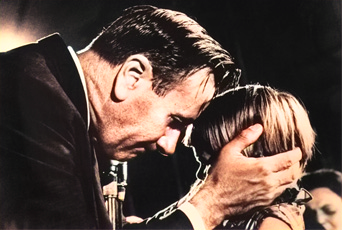
O. L. JAGGERS
O. L. JAGGERS
January 8, 1916 – January 10, 2004
Orval Lee Jaggers was born January 8, 1916, the son of David B. Jaggers, a Pentecostal preacher, and his wife, Fludie L. Jaggers (née Detrick) in Dardanelle, Arkansas.
He began his ministry in his mid-twenties, in 1941as an Assemblies of God minister in rural Missouri and rose to prominence in the healing movement in the late 40s. He attended one of the early Branham campaigns in Arkansas, saw the potential of union meetings and began holding auditorium revivals immediately. He soon was one of the leading figures in the Voice of Healing group.
After holding successful meetings throughout the country he moved to Los Angeles in 1952 and began a revival series on April 13 at Calvary Temple, pastored by Rev. Leroy Kopp. After two weeks, Jaggers moved the revival to the Olympic Arena for a further four weeks. On the revival’s ninth week, he rented the Shrine Auditorium Sunday afternoons while continuing daily meetings at Calvary Temple. He concluded his first Los Angeles crusade after eleven weeks of meetings and in August, reconvened meetings at the “Great Tent Cathedral” at Washington and Hill Streets. Jaggers then made arrangements to purchase the Calvary Temple where he opened the World Church in Oct 4, 1952. From his early days in ministry Dr. Jaggers used radio and television to broadcast his ministry to a wide audience. His voice has been heard in person or on the airwaves in over 70 countries.
Jaggers called the “phenomenal rise and growth” of his church “the most remarkable success story of the 20th century.” In 1956, he announced that the church had a membership over 10,000 and that “additional applications have also been submitted for membership which have not been passed upon.” At that time the church had a seating capacity of 3,000 and Jaggers’ plans were grandiose:
Jaggers was a tremendous preacher, possibly the greatest of the revival. But he sported a vivid imagination which gave rise to extravagant claims and exaggerated reporting. Along with one or two other leading evangelists his method of combatting accusations and criticism was to play the martyr card, claiming he was being persecuted by Satanic forces for the Gospel’s sake. These forces, he claimed, included communism, the red conspiracy, ecclesiastical leaders, including full Gospel denominations. Jaggers response was to fight back, even attacking the Pentecostal churches and also some of the leading figures in the revival.
Over time his doctrinal views were considered more and more extreme. Embracing such ideas as the miraculous flowing of miracle oil, physical immortality and that Christians could have eternal life on earth, he was clearly moving away from the orthodox position. Despite pleas from other leaders like William Branham who publically urged Jaggers “Come back and stay with the Gospel,” he gradually estranged himself from the movement, ultimately abandoning healing revivalism altogether.
Tony Cauchi
Januray 2012
Bibliography: D. Harrell, Jr., All Things Are Possible (1975); Art: L. F. Wilson, International Dictionary of Pentecostal and Charismatic Movements (2002); http://www.universalworldchurch.org/wiki/Rev._Dr._Orval_Lee_Jaggers